Change or rekey · Oshawa
Deadbolt Installation
The front door has a handsome lever and a keyed knob, and that is all. Nothing above it.
Deadbolt Installation
In plain words
Steel-clad and fibreglass doors, the common insulated entry doors in newer subdivisions, take a deadbolt happily as long as they are cut for it properly. The skin is thin metal or resin over a foam core, often with a wood block at lock height, so the cross bore is made with a hole saw suited to the skin, at low speed, and the edge is finished with a plate rather than a chisel mortise. Solid wood doors in older homes are cut conventionally, with care for splitting at the edge. The locksmith reads the door before drilling and picks the method that leaves a clean opening and a true-running bolt.
How the visit goesYou moved in three weeks ago. The previous owner left a handful of keys, none labelled, and the bolt on the side door rattles in its housing. You would like every exterior door to bolt, and to know exactly who can open it.
Oshawa
How the visit goes
What the door is made of
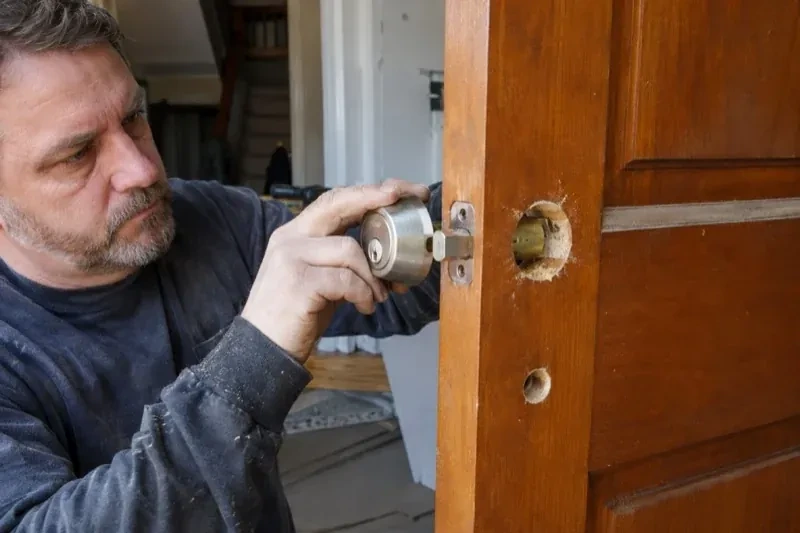
The first thing the locksmith reads is the door itself, because it decides how the holes get cut. A solid wood slab in a century home bores cleanly but can split at the edge if the mortise is rushed. A steel-clad insulated door has a thin metal skin over foam, sometimes with a wood block at lock height, and needs a metal-cutting hole saw run slowly. Fibreglass behaves like a hard plastic and chips if the bit grabs. Thickness matters too: most exterior doors are 44 mm, some older ones 35 mm, and the deadbolt's screws and collar have to suit that. Ten seconds with a tape and a knuckle on the face answer all of this.
Marking and boring a fresh door
With the height agreed, the paper template is folded over the door edge and the two centres are marked: the cross bore on the face and the edge bore on the stile. A boring jig clamps over the door so the hole saw cannot wander, and the cross bore is cut from both faces to leave clean veneer or skin on each side. The edge bore is drilled with a 25 mm bit through the stile until it meets the larger hole. The locksmith then traces the bolt faceplate on the edge and chisels a shallow mortise so the plate sits flush, keeping the cut inside the lines so the edge stays sound.
A record for the home file
You should know what is on your door in plain terms, so the visit closes with a short account: the model and grade of deadbolt fitted, its finish, the backset and bore it sits in, whether the cylinder was keyed alike or set to a new key, how many keys were cut, and what was done on the frame side. For a rental, this note is useful for the landlord or building manager, who under tenancy rules is entitled to know what lock is on the unit and to hold a key. For an owner it is one line in the house file that makes the next locksmith visit, whenever it comes, a simpler conversation.
Deadbolt Installation
In the van
- Strike box
- 25 mm auger bit
- Reinforced strike plate
- Boring jig and 54 mm hole saw
- Single-cylinder deadbolt
What affects the quote
Same fees day, night or weekend
1Removing and disposing of the old hardware
Some visits end with the old deadbolt and strike left with the homeowner, and others ask for it to be removed and hauled away. Taking the old hardware away adds a small amount of time and is agreed before the new deadbolt goes in.
2Finish and trim style
Coated finishes built for salt and sun, matching trim for an existing handleset, and low-profile faces cost differently from a standard brass or nickel unit, and you choose the level.
3Hardware supplied by you or by the locksmith
If you have already bought the lock, the quote covers labour and any adaptation of the door to that kit. Hardware supplied from the van is listed separately with its grade and finish.
Deadbolt Installation: questions
Someone forced my door. Can the new deadbolt go into the same frame?
In most cases, yes. The locksmith examines the jamb for splits and stripped screw holes, glues and pins any cracked section, and fits a full-length jamb reinforcer under the strike so the new long screws bite into sound wood and the stud behind. A new pocket is bored to the correct depth. Where the jamb is beyond repair, replacing that section of frame is discussed before any lock goes on.
How long does a deadbolt installation take?
A replacement into existing holes is generally the shorter visit, and boring a fresh door with a new strike takes longer, roughly an hour or two per door including the frame work and testing. Steel doors, keying alike, frame repairs after a forced entry and fitting a jamb reinforcer each add time. The locksmith can give a realistic estimate once the door and frame have been looked at.
Can the new deadbolt use the same key as my other doors?
Usually, yes. If the new lock shares a keyway with your existing cylinders, the locksmith repins it on the bench so your current key operates it, and nothing changes on anyone's ring. If the keyways differ, the other doors can be brought onto the new key instead. Say which key you want to keep before the hardware is chosen, because keyway is part of picking the lock.
Change or Rekey Locks
- Lock Replacement & UpgradeThe brass handleset has gone blotchy and green where the winter salt reaches it, and the coating on…
- Vintage Mortise Lock ServiceYou bought a house with its original hardware and a bag of loose keys.
- Smart Lock InstallationThe kids get home before you do and the spare key has been lost twice this school year.
Deadbolt Installation near you
Every lock service we provide in Oshawa starts with the same first step, which is looking at the door properly before deciding anything. The individual pages below explain what that look involves for each job, how the work is carried out, and what to expect from the hardware afterwards.