Commercial · Oshawa
Master Key System Design
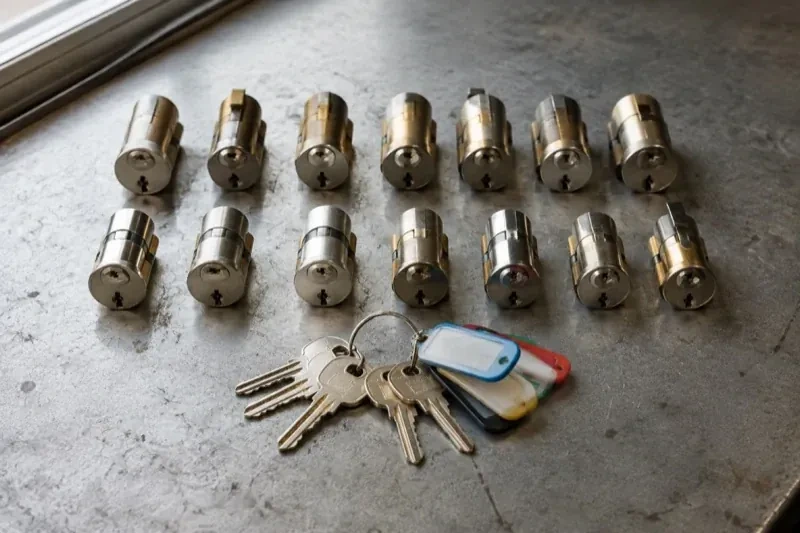
A property manager taking over a small commercial building inherits a shoebox of keys with no labels and no chart. Some open the mechanical room, some open vacant units, and a few do not seem to match anything currently on the property at all.
Master Key System Design
In plain words
Many commercial properties end up with keys copied from other keys over years of staff changes, until nobody can say with confidence what a given key actually opens. Master key system design starts from the opposite direction: an approved list of roles and openings comes first, and the keying follows it. Doors that genuinely need to share access are grouped under a sub-master; doors that do not stay on their own key. Once the hierarchy is agreed, the cylinders are pinned to match it, tested lock by lock, and handed over with a plain record so the business always knows which key belongs where.
How the visit goesOn the warehouse floor, a shift supervisor's key opens the loading dock, the tool crib and the manager's office, though only the dock is really part of the job. Nobody planned it that way; the key was simply copied from whichever one was closest at hand.
Oshawa
How the visit goes
Who holds the top-level master
A single top-level master, if the property has one at all, is deliberately kept to the shortest list the business can operate with. The check here is a direct conversation about who genuinely needs to open every door on the property versus who only thinks they might one day, since every extra holder is another way a full-access key can go missing. This conversation happens before cutting begins, because narrowing the list afterward means recovering and replacing keys that have already been issued to people no longer on it.
Marking and cutting the actual keys
Keys are cut to the bittings set out in the key schedule and marked in a way that identifies the holder's role or level rather than the door or address it opens, so a key found on its own gives away as little as possible about the building it belongs to. Quantities match what was agreed during the assessment, with each one logged by serial against the person or role receiving it. Blanks for a restricted keyway are cut only against the owner's authorization, keeping future duplication inside the same controlled record.
Room already built in for what comes next
Because spare capacity was planned into the keying platform from the start, a realistic new door, tenant or hire usually fits into the existing chart without disturbing levels that are already in use. This is the practical payoff of building the system with growth in mind rather than filling every available combination on the first day: expansion becomes an addition to the record, not a reopening of it.
Master Key System Design
In the van
- Key marking tools
- Plug follower and key gauge
- Bench test fixture
- Change and master keys
- Restricted or standard key blanks
What affects the quote
Same fees day, night or weekend
1Testing scope before handover
Testing every cylinder individually and then testing each master and sub-master across its full group takes time proportional to how many doors and levels exist. A larger hierarchy with more levels to verify against more doors adds to that testing time.
2How many locations are involved
A single building is simpler to assess and pin than several sites intended to share related levels of access. Travel between locations, and keeping the hierarchy consistent across more than one property, both add to the overall scope of the project.
3Administrator training and handover time
Walking the named administrator through the chart, the issuance process and how to handle a future lost key or new hire takes a defined amount of time on the day of handover, and a more detailed walkthrough for a larger, multi-level system takes longer than a simple one.
Master Key System Design: questions
Can key duplication be restricted so copies cannot be cut elsewhere?
Yes. With a restricted or patented keyway, blanks are only available through the manufacturer's authorized record, so a copy is not cut at an ordinary hardware counter without going through that channel. This does not make a key impossible to duplicate, but every legitimate copy passes through a record the owner controls, which a standard keyway cannot offer.
What is a restricted keyway and do I need one?
A restricted or patented keyway limits who can cut a copy of your keys to whoever holds the manufacturer's authorization record, rather than any hardware counter. It suits doors behind which cash, records or controlled supplies sit. A standard keyway is simpler to administer and works well for lower-risk doors where duplication control matters less.
Can electronic locks be part of the same system as mechanical keys?
Yes. Where a property mixes keypad or card doors with mechanical cylinders, the access levels are designed to line up across both, so a department sitting at one sub-master level mechanically holds a matching level electronically. Mechanical override cylinders behind an electronic lock are pinned into the same chart as every other door, so one record still describes the whole property.
Commercial Locks
- Access Control InstallationDeliveries arrive before anyone is scheduled to be there, which right now means either propping the…
- Panic & Exit HardwareThe new access-control reader at the staff entrance works fine going in, but nobody has sorted out…
- Commercial-Grade Lock ReplacementThe kitchen delivery door gets shouldered open more than a hundred times a shift, and lately the…
Master Key System Design near you
Every lock service we provide in Oshawa starts with the same first step, which is looking at the door properly before deciding anything. The individual pages below explain what that look involves for each job, how the work is carried out, and what to expect from the hardware afterwards.